An earlier posting noted that people who lose in ‘reality’ talent competitions on television usually describe their experience as a ‘journey’. This is one of many clichés. Some people claim to be ‘born again’, others to have reached a ‘turning point in their life’. At times we have a sense of opportunities not taken and difficult tasks preferred, as in Robert Frost’s wonderful poem:
Two roads diverged in a yellow wood,
And sorry I could not travel both
And be one traveller, long I stood
And looked down one as far as I could
To where it bent in the undergrowth;
Then took the other, as just as fair,
And having perhaps the better claim,
Because it was grassy and wanted wear;
Though as for that the passing there
Had worn them really about the same,
And both that morning equally lay
In leaves no step had trodden black.
Oh, I kept the first for another day!
Yet knowing how way leads on to way,
I doubted if I should ever come back.
I shall be telling this with a sigh
Somewhere ages and ages hence:
Two roads diverged in a wood, and I-
I took the one less travelled by,
And that has made all the difference.
Most of the time, however, we do not experience choice of this kind: we just see signs on the road that tell us that for some time our lives have been heading in an unexpected direction. This is true of the experience of ageing. My first such sign was in 2001 on the Great Barrier Reef near Port Douglas in Far North Queensland. The family had split up for the day - my wife went on trip in a glass-bottom cruiser and I took my two children (then aged 15 and 12) on an escorted snorkelling expedition. I made the usual assumption of fathers that my job was to protect my children while encouraging them to explore. But they swept ahead after the group leader, plunging down to follow a large turtle along the Reef. I was unable to keep up, floundered, and surfaced. I saw the boat a few yards away, and wondered if I would reach it. My children, I realised, needed to look after me.
Now I have passed another sign of ageing - retirement. On Friday, I went to a party at the University organised and paid for by my most generous colleague Dr Qulsom Fazil. I am also grateful to all the people who came and wished me well, and for generous gift. Anyway, this is voluntary early retirement. I intend to carry on teaching intellectual disability, preparing distance learning texts, and writing about social policy. But I will have more time to also write to prisoners of conscience, to improve my language skills, and to walk through the hills and fields of Worcestershire.
http://stuartcumella.blogspot.com/2009/04/cliche-rears-its-ugly-head.html
Sunday, 28 March 2010


Sunday, 21 March 2010
Memories of the British Empire
The main road running East-West through central Vancouver is called ‘Broadway’. When you drive along it, the names of the streets which cut across it are hung above the road. Driving East after Alma Street, you cross over Collingwood Street and Waterloo Street, Blenheim Street and Balaclava Street, and then Trafalgar Street. Names of the battles and heroes of the British Empire in the 19th Century are found all over Canada, Australia and New Zealand, together of course with streets, parks, gardens, cities and towns and one Australian state named after Queen Victoria herself. They are part of the cultural heritage of Britain, as much as the English language, the rule of law, representative government, fish and chips, and the kilt and the bagpipes.
As British people settled in different lands, they adapted this heritage to take account of the native people and settlers from other countries, the strange new landscape they found themselves in, and the very distance from the mother country. They innovated new ways of building, farming, and governing themselves, and also new ways of speaking English. The most extraordinary adaptation to the lives of the native peoples took place in Canada, where British and French settlers learnt from the First Nations how to survive, travel and trap fur in the vast boreal North of the country. Adaptation to the new landscape came more slowly. For several generations, British settlers tried to make their new land resemble the old - importing plants, animals and pests, and creating gardens of rose bushes and herbaceous borders. Eventually, their descendents came to love and feel at home in the bush, and venerate indigenous trees and animals and national symbols. Their farmers adapted to the opportunities of a warmer climate, and in New Zealand and Australia developed the best wines in the world.
To a visitor like myself, the most striking signs of innovation in Canada, Australia and New Zealand are the towns and the buildings. In all three countries, the smallest communities have very wide streets, often set out in grid. Many have wooden buildings with elaborate facades, while, particularly in New Zealand, shops have ‘verandas’ (canopies over the street to protect the pedestrian from rain and the sun). These superb vernacular building styles are shown below, from Trafalgar Street in Nelson, New Zealand.
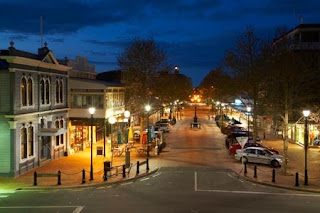
For comparison, there is a photograph, below, from the beautiful town of Nelson, British Columbia.

All of these countries settled from the British Isles have subsequently received people from many different lands. But the continuity with Britain remains strong. In 2003, my family visited Eastern Canada and one day came to Fredericton, the capital of the Province of New Brunswick. Fredericton was named after one of the sons of King George III, and was first settled by loyalists moving North after the American Rebellion. It is a small city, noted for its educational institutions and its support of the arts. There is a fine cathedral in English Gothic style facing a provincial parliament building, which, like most parliaments in the former British Empire is Gothic rather than Grecian or Roman in appearance. This is an outward display of the political theory that freedom is based on the continuity of the law rather than abstract reason. I asked to visit the provincial parliament building, and was surprised to find the Provincial Assembly in session. Speeches were bilingual, with each member switching easily between English and French. As I left, an august lady swept from her car to enter the building. She was the lieutenant governor, arriving to sign into law the bills that had just been voted by the assembly. I felt pleased and proud that such a civilised way of life, with its origins in the best British traditions, was maintained so well amidst a vast and beautiful wilderness of forests and mountains.
As British people settled in different lands, they adapted this heritage to take account of the native people and settlers from other countries, the strange new landscape they found themselves in, and the very distance from the mother country. They innovated new ways of building, farming, and governing themselves, and also new ways of speaking English. The most extraordinary adaptation to the lives of the native peoples took place in Canada, where British and French settlers learnt from the First Nations how to survive, travel and trap fur in the vast boreal North of the country. Adaptation to the new landscape came more slowly. For several generations, British settlers tried to make their new land resemble the old - importing plants, animals and pests, and creating gardens of rose bushes and herbaceous borders. Eventually, their descendents came to love and feel at home in the bush, and venerate indigenous trees and animals and national symbols. Their farmers adapted to the opportunities of a warmer climate, and in New Zealand and Australia developed the best wines in the world.
To a visitor like myself, the most striking signs of innovation in Canada, Australia and New Zealand are the towns and the buildings. In all three countries, the smallest communities have very wide streets, often set out in grid. Many have wooden buildings with elaborate facades, while, particularly in New Zealand, shops have ‘verandas’ (canopies over the street to protect the pedestrian from rain and the sun). These superb vernacular building styles are shown below, from Trafalgar Street in Nelson, New Zealand.

For comparison, there is a photograph, below, from the beautiful town of Nelson, British Columbia.

All of these countries settled from the British Isles have subsequently received people from many different lands. But the continuity with Britain remains strong. In 2003, my family visited Eastern Canada and one day came to Fredericton, the capital of the Province of New Brunswick. Fredericton was named after one of the sons of King George III, and was first settled by loyalists moving North after the American Rebellion. It is a small city, noted for its educational institutions and its support of the arts. There is a fine cathedral in English Gothic style facing a provincial parliament building, which, like most parliaments in the former British Empire is Gothic rather than Grecian or Roman in appearance. This is an outward display of the political theory that freedom is based on the continuity of the law rather than abstract reason. I asked to visit the provincial parliament building, and was surprised to find the Provincial Assembly in session. Speeches were bilingual, with each member switching easily between English and French. As I left, an august lady swept from her car to enter the building. She was the lieutenant governor, arriving to sign into law the bills that had just been voted by the assembly. I felt pleased and proud that such a civilised way of life, with its origins in the best British traditions, was maintained so well amidst a vast and beautiful wilderness of forests and mountains.
Wednesday, 17 March 2010
Modest proposals for reducing poverty in the UK
Now that an election is near in Britain, our political parties have once again discovered that many of our people live in poverty. Poor people may lack the resources to bankroll political parties and are unlikely to make the dinner tables of senior politicians, but there are an awful lot of them, and they have votes. About a fifth of the population of the UK has an annual income of less than 60% of the median. For a single person, ‘poverty’ is therefore defined as a weekly income of less than £115 after tax and housing costs are met (see the website http://www.poverty.org.uk/summary/key%20facts.shtml. Reducing poverty would mean increasing wage rates for those on or near the minimum wage, and raising welfare benefits (particularly for families with young children). This is expensive, and would require unwelcome action for governments, like increasing tax on the very wealthy or diverting the billions of pounds of public money spent on the privatisation-management consultancy-IT complex.
So here are my own ideas for what government can do:
1. Declare all low wage earners to be non-domiciliary. Most people living in poverty who are of working age live in households in which one or more people are in work. Yet they still pay income tax and national insurance on their miserably low earnings. Very wealthy people such as Lord Ashcroft and Zac Goldsmith have avoided this inconvenience by declaring themselves ‘non-domiciliary’ in the UK, even though this is where most of their income is derived. I would extend this privilege to all people on low incomes, who can be given notional residence in the Cayman Islands, Jersey, or other locations for tax refugees which happen conveniently to come under the British crown.
2. Declare all poor people who live in houses with gardens to be farmers. Farm subsidies are always presented as a means of supporting low-income farmers. In fact, most of the cash goes to big land-owning corporations and the most wealthy farmers (the Duke of Westminster, the richest man in England, receives £300,000/year). Landowners also get a subsidy not to grow anything at all (called ‘set aside’). My plan would be to extend these EU subsidies to all low income people with gardens. They would receive guaranteed minimum prices for the potatoes, runner beans etc they grow in their back gardens and allotments, or set-aside payments if they grow grass, flowers or concrete. This would all come from EU funds, and so would have limited impact on British government expenditure.
3. Set up local versions of the House of Lords in each area of deprivation. Members of the House of Lords currently get £80/day attendance allowance on a SISO basis (‘SISO’ means sign in - sod off). There is also an overnight allowance of £160 and generous allowances for travel and other costs supposedly associated with having a title. In my plan, membership of each local house of lords would be open to people on low incomes who are not eligible for the first two payments I have proposed (ie those who are not receiving a wage and do not have a garden). Getting poor people to advise on poverty would also be a pleasant change from paying large sums to management consultants and academics to undertake this task.
So we can see that Britain has one of the best welfare states in the world for wealthy people. All we need to do now is to extend it to the poor.
So here are my own ideas for what government can do:
1. Declare all low wage earners to be non-domiciliary. Most people living in poverty who are of working age live in households in which one or more people are in work. Yet they still pay income tax and national insurance on their miserably low earnings. Very wealthy people such as Lord Ashcroft and Zac Goldsmith have avoided this inconvenience by declaring themselves ‘non-domiciliary’ in the UK, even though this is where most of their income is derived. I would extend this privilege to all people on low incomes, who can be given notional residence in the Cayman Islands, Jersey, or other locations for tax refugees which happen conveniently to come under the British crown.
2. Declare all poor people who live in houses with gardens to be farmers. Farm subsidies are always presented as a means of supporting low-income farmers. In fact, most of the cash goes to big land-owning corporations and the most wealthy farmers (the Duke of Westminster, the richest man in England, receives £300,000/year). Landowners also get a subsidy not to grow anything at all (called ‘set aside’). My plan would be to extend these EU subsidies to all low income people with gardens. They would receive guaranteed minimum prices for the potatoes, runner beans etc they grow in their back gardens and allotments, or set-aside payments if they grow grass, flowers or concrete. This would all come from EU funds, and so would have limited impact on British government expenditure.
3. Set up local versions of the House of Lords in each area of deprivation. Members of the House of Lords currently get £80/day attendance allowance on a SISO basis (‘SISO’ means sign in - sod off). There is also an overnight allowance of £160 and generous allowances for travel and other costs supposedly associated with having a title. In my plan, membership of each local house of lords would be open to people on low incomes who are not eligible for the first two payments I have proposed (ie those who are not receiving a wage and do not have a garden). Getting poor people to advise on poverty would also be a pleasant change from paying large sums to management consultants and academics to undertake this task.
So we can see that Britain has one of the best welfare states in the world for wealthy people. All we need to do now is to extend it to the poor.
Tuesday, 9 March 2010
A survey has shown that...
If you want to get publicity for some idea, promote a product, or just get in the news, then you should report the results of a meaningless survey. Search on Google using the phrase "a survey has shown that...", and you will see what I mean. You will learn that one in six therapists have tried to cure homosexuals, that more than 70% of people would exchange their computer password for a bar of chocolate, that Americans who attend church are more likely to favour torture than those that do not, and so on. You don't need to bother with getting a good response rate, a representative sample, or even a valid and reliable questionnaire. Just circulate some questions to a few people, and send the most eye-catching result to the press.
There are also plenty of meaningless surveys which never get to the press, but are circulated within companies, government departments and universities. These are often promoted as 'quality assurance', and are even taken seriously by some people. Management boards ponder reasons for a fall in satisfaction ratings by 5% on a survey with a response rate of 20%, without admitting that the whole exercise does not mean very much. Truth to tell, survey results might not mean much even if the response rate was 100%. Many meaningless surveys use ambiguous questions coupled with dubious Likert scales (the kind which assign numerical scores to a range of five or so questions from 'very satisfied' to 'very dissatisfied'). These have the apparent advantage of producing a numerical score and hence allowing statistical analysis. Usually however, people only look at mean scores, and these can be misleading. A survey in which 50% of respondents were 'very satisfied' and 50% 'very dissatisfied' would produce the same mean score as one in which 100% said they were 'neither satisfied or dissatisfied'.
What's the alternative? It is essential for organisations to assess the quality of what they do, and their customers/citizens/students are in a good position to assess this. Rather than assessing mean scores on Likert scales, organisations should concentrate their attention on the causes of satisfaction and dissatisfaction, and ideas for improverment. The best way of doing this is probably to use open-ended interviews or focus groups. Of course, this would require quality assurance staff to be skillful in survey techniques, to be creative, and to be prepare to co-operate with front-line staff rather than stand in judgement over them.
There are also plenty of meaningless surveys which never get to the press, but are circulated within companies, government departments and universities. These are often promoted as 'quality assurance', and are even taken seriously by some people. Management boards ponder reasons for a fall in satisfaction ratings by 5% on a survey with a response rate of 20%, without admitting that the whole exercise does not mean very much. Truth to tell, survey results might not mean much even if the response rate was 100%. Many meaningless surveys use ambiguous questions coupled with dubious Likert scales (the kind which assign numerical scores to a range of five or so questions from 'very satisfied' to 'very dissatisfied'). These have the apparent advantage of producing a numerical score and hence allowing statistical analysis. Usually however, people only look at mean scores, and these can be misleading. A survey in which 50% of respondents were 'very satisfied' and 50% 'very dissatisfied' would produce the same mean score as one in which 100% said they were 'neither satisfied or dissatisfied'.
What's the alternative? It is essential for organisations to assess the quality of what they do, and their customers/citizens/students are in a good position to assess this. Rather than assessing mean scores on Likert scales, organisations should concentrate their attention on the causes of satisfaction and dissatisfaction, and ideas for improverment. The best way of doing this is probably to use open-ended interviews or focus groups. Of course, this would require quality assurance staff to be skillful in survey techniques, to be creative, and to be prepare to co-operate with front-line staff rather than stand in judgement over them.
Saturday, 27 February 2010
Superficial comments on Tokyo
I landed in Tokyo early Saturday morning (20th February) and immediately began the unreliable art of summarising a country and a civilisation on the basis of a few day's visit. I am not alone in doing this. I have watched numerous reports on Japan from journalists who, like me, do not speak Japanese, know little of its history and are unfamiliar with its culture and complexity. Their reports always feature a film from a Shinkansen (bullet train), shots of crowded streets with neon signs, and dark tales of a declining economy, conformity under challenge and so on. I suspect these opinions were not based on observing what was around them, but on repeating what they had heard from other journalists and on what they thought their audience expected to hear.
My superficial impressions differ in being based, where possible, on what I actually saw. I saw a city that is almost entirely made of concrete but is not a jungle. There are none of the obvious signs of personal dereliction found in many European and North American cities. People are remarkably polite and tolerant of strangers. Far from dull conformity, people (especially young people) express their individuality in their clothes and personal style. The City is far from beautiful, but it works as a city. There is a phenomenally efficient public transport system, little sign of public disorder, and the streets are clean. Oh - and there are the best neon signs I have seen anywhere in the world.
My superficial impressions differ in being based, where possible, on what I actually saw. I saw a city that is almost entirely made of concrete but is not a jungle. There are none of the obvious signs of personal dereliction found in many European and North American cities. People are remarkably polite and tolerant of strangers. Far from dull conformity, people (especially young people) express their individuality in their clothes and personal style. The City is far from beautiful, but it works as a city. There is a phenomenally efficient public transport system, little sign of public disorder, and the streets are clean. Oh - and there are the best neon signs I have seen anywhere in the world.
Friday, 12 February 2010
How to stifle innovation
For big commercial organisations, innovation is a requirement and a threat. Innovation is essential because it provides a means of developing products that are more attractive to their consumers than those of rival firms, or at least can be produced at lower cost. A reputation can also be useful in marketing: Apple can announce some re-design of an existing device, cunningly presented to resemble our idea of the modern (sleek, smooth, and shiny). But innovation is also destructive: old product lines are closed and their workers displaced. Whole companies disappear, and the towns that depended on them decline and empty. Few universities have closed, but departments, courses and research teams have. Scientific reputations have been lost, and well-established theories ridiculed and discredited.
There will therefore always be resistance to innovation, and this will be most successful when rival organisations can either be eradicated or (for the time being) ignored. There are several ways to stifle innovation. One is to reward conformity, and promote people regarded as being ‘a safe pair of hands’. By contrast, innovative people should be identified and excluded from promotion or, in more authoritarian societies, from life itself. But heretics are persistent, and other means of stifling their ideas are needed. One that is particularly successful is to regulate every aspect of organisational life in detailed procedures manuals, quality assurance rituals, and the kind of job descriptions that comprise series of bullet-point lists. This method essentially outlaws the kind of local innovation that generates change in organisations and societies. Instead, things can only change when everyone changes. The organisation thereby innovates at the pace of the slowest or, more likely, not at all. The final means of stifling innovation is to generate a culture of smug superiority: this usually involves asserting that potential rivals are inferior without bothering to find out if this is the case. After all, why go through all the fuss and disturbance of innovation when you are already the best there is.
These techniques succeeded in resisting innovation for centuries in the great empires of the past. Egypt, Rome and the later Chinese Empire were technically stagnant, believing themselves to be protected by legions, deserts, seas and great walls from the threat of rivals. These rivals were weaker and more disorderly, and hence less willing to resist innovation. The Roman Empire was eventually destroyed by tribes which had learnt how to use stirrups and hence could ride heavy cavalry horses. The small European states, locked in perpetual warfare with each other, refined the gunpowder technology invented by the Chinese to bring about the destruction of the vast and populous Chinese Empire.
Not just empires lie in ruins. Every day I travel to work, my train passes a large cleared space at Longbridge in Birmingham, where there was once the largest car factory in Europe. On the other side of the City, there once stood the largest motor bike factory in the world. Further North are the remains of yards which a century ago built half the world’s shipping. These empty spaces and ruins are all the products of organisations which successfully resisted innovation. How I wish they had failed to do so.
There will therefore always be resistance to innovation, and this will be most successful when rival organisations can either be eradicated or (for the time being) ignored. There are several ways to stifle innovation. One is to reward conformity, and promote people regarded as being ‘a safe pair of hands’. By contrast, innovative people should be identified and excluded from promotion or, in more authoritarian societies, from life itself. But heretics are persistent, and other means of stifling their ideas are needed. One that is particularly successful is to regulate every aspect of organisational life in detailed procedures manuals, quality assurance rituals, and the kind of job descriptions that comprise series of bullet-point lists. This method essentially outlaws the kind of local innovation that generates change in organisations and societies. Instead, things can only change when everyone changes. The organisation thereby innovates at the pace of the slowest or, more likely, not at all. The final means of stifling innovation is to generate a culture of smug superiority: this usually involves asserting that potential rivals are inferior without bothering to find out if this is the case. After all, why go through all the fuss and disturbance of innovation when you are already the best there is.
These techniques succeeded in resisting innovation for centuries in the great empires of the past. Egypt, Rome and the later Chinese Empire were technically stagnant, believing themselves to be protected by legions, deserts, seas and great walls from the threat of rivals. These rivals were weaker and more disorderly, and hence less willing to resist innovation. The Roman Empire was eventually destroyed by tribes which had learnt how to use stirrups and hence could ride heavy cavalry horses. The small European states, locked in perpetual warfare with each other, refined the gunpowder technology invented by the Chinese to bring about the destruction of the vast and populous Chinese Empire.
Not just empires lie in ruins. Every day I travel to work, my train passes a large cleared space at Longbridge in Birmingham, where there was once the largest car factory in Europe. On the other side of the City, there once stood the largest motor bike factory in the world. Further North are the remains of yards which a century ago built half the world’s shipping. These empty spaces and ruins are all the products of organisations which successfully resisted innovation. How I wish they had failed to do so.
Saturday, 6 February 2010
The Conservative mood
Conservatism is more a mood or temperament than a philosophy. This is easily recognised. A conservative is generally suspicious at best of innovation, and fearful at worst. He is inclined to think that human life is diverse and varied, and better lived in a predictable routine than subject to incessant diversions. This mood applies to societies as a whole: these are seen as complex networks of obligations and hierarchies, rather than the application of rational design. Opposition to ‘rationalism’ is a key theme in conservative self-justification. Conservatives see life as the exercise of skills that are learnt through performance and habituation, rather than from textbooks and manuals. These beliefs have implications for the conservative view of political and social leadership. Leaders are seen as being drawn best from those who have accumulated expertise through practice and experience, to be acquired in part as a member of a traditional ruling elite, or at least from a background where people are expected to fill positions of leadership in business, the military, or some other field of achievement.
The conservative mood in politics has some appeal, particularly as a counter to management and economic rationalism, which sees all human activity as a means of accumulating wealth and places no monetary value on custom, art, beauty or devotion. The conservative opposition to rationalism also produces an unwillingness to consider large-scale social engineering, intended to coerce people into what reformers regard as a better way of life. Conservatism too can be a basis for tolerance of different cultures and societies: if these are indeed complex and based on tradition, then they will be expected to vary and be self-justified. No true conservative would imagine that other cultures and societies can be remade on a rational basis, nor turned into imitations of our own.
But conservatism has limitations. Conservatives often resist worthy innovations until they become an accepted part of life, which they then feel obliged to defend. Talented people from outside the usual social elites are blocked from advancement in preference to unimaginative dullards with manners, social connections and conventional views. At its worst, conservatism becomes tainted by a fearful xenophobia and the arrogance of the powerful. These have unfortunately been dominant characteristics of conservative political movements in many countries. In some cases, as with Thatcher’s government in the UK, conservative politicians inflict destructive changes to national life as a means of consolidating their own power and the wealth of their supporters.
It is, however, possible to imagine a humane conservatism, without these destructive tendencies. A humane conservatism would involve respect for the customs of the multiple and diverse communities of modern society, and promote families and communities rather than the state as the true basis for effective social action. It would protect people from political excess by establishing the importance of human rights, and would protect the wealth, possessions and occupations of ordinary people as well as of the wealthy. It would not, in other words, have done most of what governments in the UK, both Conservative and ‘New Labour’, have done in the past 30 years.
The conservative mood in politics has some appeal, particularly as a counter to management and economic rationalism, which sees all human activity as a means of accumulating wealth and places no monetary value on custom, art, beauty or devotion. The conservative opposition to rationalism also produces an unwillingness to consider large-scale social engineering, intended to coerce people into what reformers regard as a better way of life. Conservatism too can be a basis for tolerance of different cultures and societies: if these are indeed complex and based on tradition, then they will be expected to vary and be self-justified. No true conservative would imagine that other cultures and societies can be remade on a rational basis, nor turned into imitations of our own.
But conservatism has limitations. Conservatives often resist worthy innovations until they become an accepted part of life, which they then feel obliged to defend. Talented people from outside the usual social elites are blocked from advancement in preference to unimaginative dullards with manners, social connections and conventional views. At its worst, conservatism becomes tainted by a fearful xenophobia and the arrogance of the powerful. These have unfortunately been dominant characteristics of conservative political movements in many countries. In some cases, as with Thatcher’s government in the UK, conservative politicians inflict destructive changes to national life as a means of consolidating their own power and the wealth of their supporters.
It is, however, possible to imagine a humane conservatism, without these destructive tendencies. A humane conservatism would involve respect for the customs of the multiple and diverse communities of modern society, and promote families and communities rather than the state as the true basis for effective social action. It would protect people from political excess by establishing the importance of human rights, and would protect the wealth, possessions and occupations of ordinary people as well as of the wealthy. It would not, in other words, have done most of what governments in the UK, both Conservative and ‘New Labour’, have done in the past 30 years.
Subscribe to:
Posts (Atom)