Saturday, 3 March 2012

The discovered country


The best part of a touring holiday is arriving at a place not in the guide books, and finding it to be beautiful and unique. I have had many such experiences. I remember a holiday in Brittany with my wife when my son Andrew was young enough to be in a pushchair. We passed through the small market town of Quintin on the way back from somewhere else, and stopped. We found streets of fine old houses and a chateau. At the chateau café, looking out on the gardens and the river, a well-dressed lady took a liking to Andrew, and fed him Madeleine cakes.

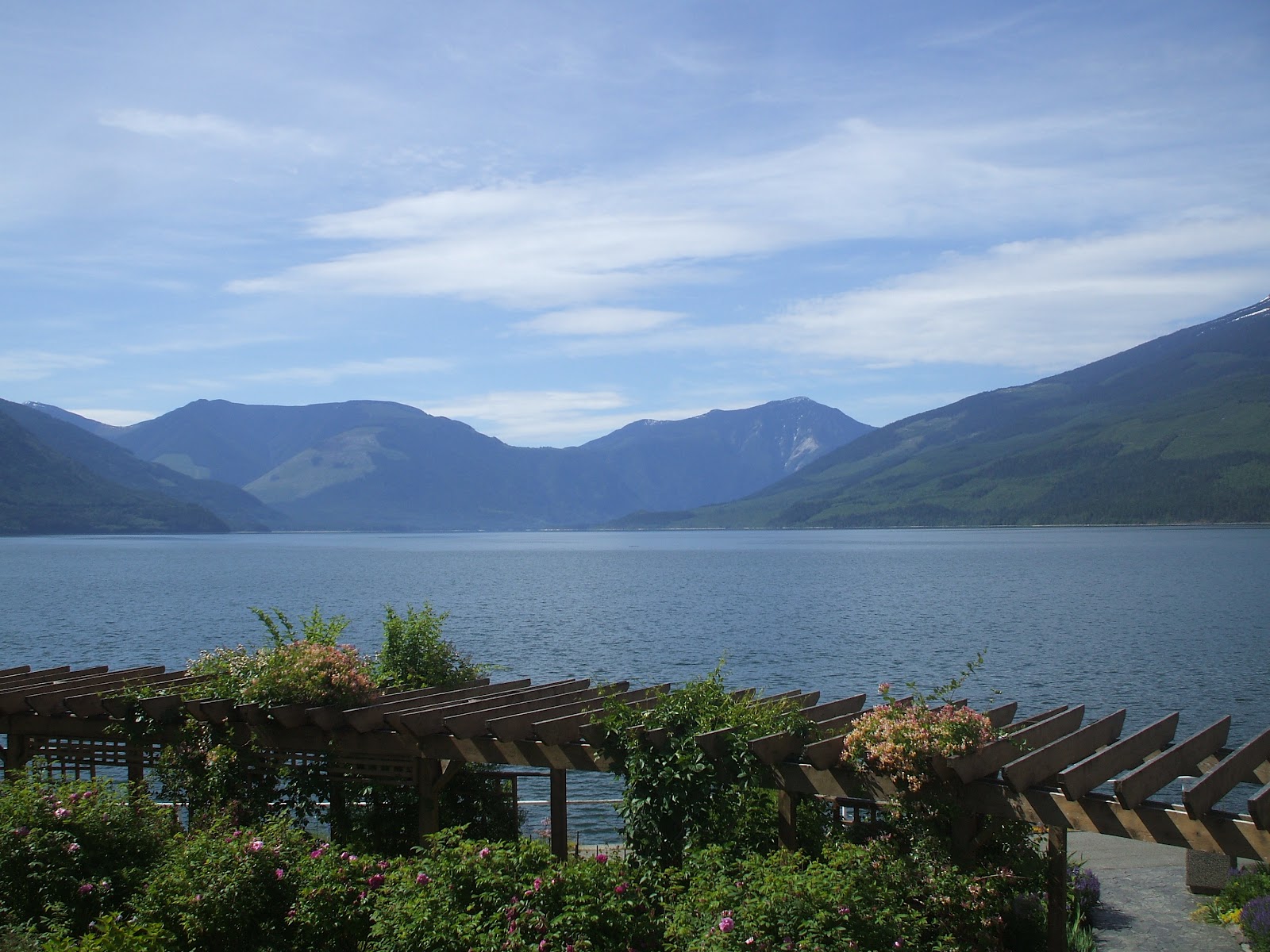
Many years later, now with an adult Andrew and an adult daughter Rosemarie, my wife and I travelled Eastwards from Vancouver. This was a quiet winding route with scenery of staggering beauty. Travel meant crossing a sequence of wooded ridges, each running North-South, with long narrow lakes in the valley floors. We travelled through EC Manning Provincial Park, Penticton, Kelowna (where we ate at an Indian restaurant whose owner was nostalgic for Birmingham), Upper Arrow Lake, and then, on the third day of travel, arrived at Nakusp. This was the perfect British Columbia village, arranged on a small grid plan, with a high street of buildings lined with the kind of wooden facades seen in wild west films.

Nakusp had once been an industrial community, but the lake had been raised and the lakeside industry had been flooded. There were now gardens and a lakeside footpath. The old Leland Hotel (built shortly after the village was established) survived, although rather closer to the lake than it once was. Built in 1892, it is ancient by BC standards. We stayed there and had a view from our bedroom window that people in Switzerland would pay thousands to see.


I wonder if the European Union has any funds for village twinning, so that people from Quintin and my own village of Martley could get to know each other? Nakusp is rather far from Martley, but I intend to visit again as a one-man twinning association.

Monday, 20 February 2012

Graduating joy

University students invest several years of their lives and thousands of pounds of their money in their education. When their course of study is complete, they feel a great sense of achievement accompanied by a desire to celebrate. How well do universities help them in this task. From my experience in England and Scotland, hardly at all. I have attended three graduations as a student, half a dozen as a member of academic staff, and three as a proud parent. I found that these graduations fell into three types:

1.    Stuffy and self-congratulatory. This was my dominant experience of graduation ceremonies, from when I graduated with my masters degree from the University of Strathclyde, my social work qualification from the University of Stirling, and my PhD from the University of London (I didn’t attend the ceremony for my first degree). Also stuffy and self-congratulatory were the degree award ceremonies I attended as a member of staff at the University of Birmingham. All of these events shared a familiar British obsession with meaningless procedures (usually ‘traditions’ of recent invention), wearing funny hats, and a complete lack of fun. In each case, large numbers of students were processed at high speed, with no recognition of their individual talents, the promise they held for the future, or the fact that all the professors, vice-chancellors, administrators and so on depended for their income on the money these students brought into the university. The most memorable of these events was at the University of London. This took place in the splendid setting of the Albert Hall, and was chaired by Princess Anne, as Chancellor of the University. Graduands were supposed to bow to her when they paraded on the stage to receive their degree. Some churlishly refused, and in each case an amused smile appeared on her face. The dullest graduation ceremonies of all were at the University of Birmingham, but the Medical School did make up for this afterwards by holding a slightly more informal reception for graduands and their parents. One irritating feature of Birmingham’s ceremonies was the refusal to honour students who graduated with diplomas and certificates rather than degrees. The University of Stirling could do this, but Birmingham preferred to exclude this group of students (but take their money of course). 

2.    Utterly commercial. All of these graduations, however, were infinitely preferable to Nottingham Trent University (NTU), where my daughter graduated with a BA in Textile Design. The University imposed charges above her fees for all the materials she used in her degree, and then charged parents for attending the graduation ceremony. In other respects, the ceremony was exactly like the others, with a large hall, boring speeches, and an endless parade of graduands. There was a meagre reception afterwards. I suggest NTU’s administration have a chat with its academic staff teaching the degree in management and marketing to learn the concept of customer care.

3.    Small and respectful. The best ceremony I attended was at Leeds University, where my son graduated with a BA in Politics. This was a small affair, limited to students in the same subject, and followed by a very friendly reception afterwards where staff, graduands and parents could meet over a buffet meal. I was pleased to find that the academic staff in the Department of Politics knew their undergraduate students well. The academic speeches were witty, and the several of the students cheered each other when they received their degree. My son went on later to the University of Leiden in the Netherlands, from where he graduated with an MSc in International Public Administration in 2011. I did not attend this ceremony, but I did see a video. This took place in the oldest building in the University, and, after the ceremony, graduands signed their name on its walls, next to centuries of previous graduates and honorary graduates. It must be nice to write your signature next to that of Albert Einstein. But what was particularly good about this ceremony was that each student’s academic supervisor made a speech outlining the subject of their dissertation and its contribution to knowledge.

I have seen pictures of graduations in other countries, which include parades of students through the local town, concerts, gigs, dances and general fun. This could happen here too, but it would need universities to recognise that their primary purpose is the dissemination of knowledge, and that they collaborate with students to achieve this, and that success in this task is grounds for real celebration. Of course, it also requires that the British middle class lose some of its dreary stuffiness and learn how to have fun.

Sunday, 5 February 2012

A few words about snow

The Eskimoes, it is reported in urban myth, have lots of words for snow. But English is sparse indeed when it comes to describing the white stuff. The media usually only distinguishes between a ‘blanket’ of snow and a ‘light dusting’. Both of these terms are ‘dead metaphors’, which must at one time have required some imagination to devise. A similar dead metaphor is used to describe ice, which is always referred to as ‘treacherous’. To the literally-minded, this would suggests that journalists believe that ice is sentient, that it aims to falsely reassure us of its safety, and then without warning and with devious malevolence becomes cold and slippy just as we choose to walk or drive on it.

The main consequence of snow, according to the media is ‘chaos’. This term, originally meaning a chasm in Greek, was later adapted by philosophers to designate the formless void that they believe preceded the act of creation (now renamed the ‘big bang’ by scientists). However, when used in the media, ‘chaos’ simply means any disruption, large or small, to transport timetables. Cars and trains are then said the ‘grind to a halt’. Of course, lines of cars lined up motionless on motorways are the very opposite of a formless void, but they still represent ‘chaos’ to journalists and the general public.

In Britain, transport disruption at the first heavy snowfall of the winter is regarded as a uniquely British phenomenon, not found in more organised countries. It thus becomes an opportunity for an intensive episode of national self-denigration. Yet, at the time of writing, cold weather and snow in much of Europe has disrupted transport and caused many deaths from accidents and exposure. This is true even in Germany (the most efficient country in the World as far as the British media are concerned). Still, it would be a pity to inject some evidence and fresh thinking into the accustomed narratives and dead metaphors. Otherwise, the pages of our newspapers would be empty and newsreaders on television would stand mute before us.

Thursday, 2 February 2012

Driving and the English brain

Rudyard Kipling did not quite say “Who knows England who only England knows?”, but the meaning is clear: no-one can hope to understand their own country until they have become familiar with other places. Only then, can they understand what makes their own land different and special. However, there is an alternative to prolonged travel abroad, and that is to learn from foreigners who have become familiar with our own land. There are of course reports and books by foreign journalists based in London, but the most interesting source of information comes from the blogs written mainly by expats about their daily lives in many different parts of England. These are conveniently gathered in the website Blog England, Expat England. Most are written by women, and include family photographs, recipes, and reports on family holidays and outings. But they also compare England with their country of origin and reflect on the differences.

The bloggers have chosen to live in this country, and are passionate about the beauty of its countryside, and the way in which ancient sites and history are packed into a small area. Those in London are fascinated by the mix of nationalities in the city, and the experience of living in what is probably the biggest collection of theatres in the world. American bloggers are puzzled by the different names for food in England, the small size of domestic appliances, and the problems navigating in a land where street names change at each junction and where city grids are almost entirely absent. But the particular, and almost insoluble, problem for many Americans is having to drive in a car with a steering wheel on the right and with manual gears.

Why should this prove so difficult? After all, a third of the world’s population live in countries which drive on the left, and most us in England adapt easily to driving in the other two-thirds. I think the reason for the particular problems experienced by Americans  lies in how our brains adapts to daily mental exercises. There has been little research on how driving affects the brain, but a study over ten years ago found that London taxi drivers have a larger hippocampus (the part  of the brain associated with navigation) than other people. Indeed, part of the hippocampus grew larger as the taxi drivers spent more time in the job. It is also possible that the layout of the car we drive may also affects how our brain operates.

Driving in the USA and Canada is a right-handed affair. The gear lever is hardly used in the automatic cars that are almost universal in these countries, and it is, in any case, to the right of the driver. There is no clutch for the left foot to use. North America is overwhelmingly right-handed when it comes to eating as well. Diners hold the food to the plate with the fork, and then cut a single bite-sized piece with the knife. The knife is then placed on the plate, the fork transferred from the left hand to the right hand, and used to bring the food to the mouth. The fork is then transferred back to the left hand and the knife is picked up with the right. This elaborate procedure seems to exist to ensure the main tasks in eating are performed only with the right hand, and to avoid the co-ordinated movement of knife and fork required by the usual European style of eating.

Even more left-right co-ordination is required in driving in Britain, Ireland and other places which drive on the left and use cars with manual gears. The left hand is frequently used to change gear and the left foot to press down on the clutch, while at the same time the right hand is used for steering and the right foot for the accelerator and brake. How does this affect our brains? Our brains are divided into two distinct hemispheres by a longitudinal fissure. The limbs on each side of our body are controlled by the opposite hemisphere. Driving (and eating) in left-hand drive countries requires a constant exchange of information and adjustment between both hemispheres. It has been found that the part of the brain connecting the two hemispheres (the corpus callosum) differs in shape between men and women, and is larger among occupational groups such as musicians. My hypothesis is that it will also differ between typical drivers in England and those in the USA. If so, it would explain why people from North America find it so hard to adjust to driving in England.

This could of course all be tested by neuroscience researchers, aided by large sums of research council funding. At least it would get them out of their labs and on to the road.

Expat blog England 

Saturday, 21 January 2012

Flooring the Beast


In May 2011, President Obama’s car was successfully attacked by an Irish speed bump. The car (called the ‘beast’) is a triumph of American engineering. When it was unveiled to the press in 2009, a spokesman said that “Although many of the vehicle’s security enhancements cannot be discussed, it is safe to say that this car’s security and coded communications systems make it the most technologically advanced protection vehicle in the world.” The BBC noted that the car probably included “bullet proof glass, an armoured body, a separate oxygen supply, and a completely sealed interior to protect against a chemical attack... Some joke the car is so tough it could withstand a rocket-propelled grenade. Its tyres are said to work flat, so the vehicle will keep going even if shot at.”

The fate of the beast and its vulnerability to a very low-tech attack by a speed bump is a metaphor for the fate of many military interventions in the last generation. The massive US effort in Vietnam was held back by an army of peasants equipped with AK47 rifles and supplied by thousands of men pushing bicycles on trails through the jungle. In Afghanistan, both Soviet and NATO armies have been defeated by tribesmen with rifles and home-made bombs. Somali pirates make vast areas of the sea unsafe despite all the navies, nuclear-powered aircraft carriers and submarines of the world. Even the Israeli Army was driven out of Southern Lebanon by the Hezbollah militia armed with obsolete Russian rockets and anti-tank missiles.

Why have armies and navies experienced such problems? One reason is that military forces need to be prepared for multiple threats, including the (hopefully rare) possibility of wars against each other. In such a conflict, armour, mobility and firepower would be crucial. They therefore compete to accumulate the best and most modern equipment, and this shapes the way they are trained and organised. The US Army, easily the best equipped in the world, took a few hours to gain victory in both its wars against the army of Saddam Hussein in Iraq. However, the same high technology weapons are less effective against warriors who do not wear uniform and merge back into the local population when their spree of killing is over. High technology armies could of course retaliate by bringing destruction on a vast scale on the civilian populations from which the guerillas come, but governments are now much less willing to wage wars of extermination than their predecessors in the last century. Instead, there have been some limited punitive or reprisal raids, such as those against Fallujah or Gaza. In the absence of action against civilian populations, the main role of soldiers in high tech armies is to be moving targets for snipers and roadside bombs.


There is a further problem with high technology forces - their very complexity. All depend on long and sometimes vulnerable supply chains, particularly for diesel and aviation fuels. The most vulnerable supply chain of all is money, and this depends on the willingness of governments to go on spending it. The experience of the Second Iraq War has shown that it is possible to mobilise public support for a limited period if the enemy can be presented as a threat to the homeland. The Libyan intervention shows that the public will support a short war of bombing. But less than a quarter of British people now believe our troops should remain in Afghanistan, and no political party in this country bothers to make a case for remaining. It is likely that future NATO policy towards that country will fall back on the old British Empire policy of ‘butcher and bolt’ - or punitive raids, carried out (nowadays by drones rather than by the Khyber Rifles) in retaliation to some terrorist outrage deemed to originate in that country.

Friday, 30 December 2011

A guide to crapitecture


Two years ago on a cold November day, I visited the Nottingham Contemporary - a new centre for the arts resembling a square black box, built on the side of a hill next to the splendid High Pavement area of the City. When we had eventually found the entrance, we discovered that there were no exhibitions at all that day, although the staff did tell us that we were free to use the (over-priced) café and buy things in the large museum shop.

Nottingham Contemporary is a archetype of what should be called ‘crapitecture’, which can be recognised from these guidelines:

1.    It is difficult to find the entrance. Before the rise of crapitecture, all builders and architects strove to make the entrance as imposing as possible. This was achieved through porticos, archways, and gatehouses. Even humble dwellings had a front door, plainly visible, often painted in bright colours to indicate the pride of the inhabitant. But crapitects see their work as a personal statement of their artistic merit - a kind of very large sculpture, and there is no front door on a sculpture.

2.    It fails in the most basic sense to meet the requirements of its occupiers. Like the Nottingham Contemporary (an art gallery without any art), crapitectural buildings fail in the most basic way to fulfill their function. Roofs leak (it helps if they are flat), vast interior atriums waste most of the internal space of the building and are expensive to heat, libraries are over-heated and noisy, and so on. Of course, the lack of exhibits is not the fault of the architects who built the Nottingham Contemporary, but there is an increasing tendency for museum buildings to attract more attention and cost more than the items they supposedly exist to display.

3.    It is located with no reference to the surrounding townscape, except in the negative sense of destroying a previously attractive local view or dominating all nearby buildings. All of us have a favourite list of such crapitectural buildings. Like most British cities, much of Nottingham has been defaced by grotesque developments - the Broadmarsh Centre which blocks off a medieval street, or the utterly vile Maid Marian Way. Nottingham Contemporary does not quite deface one of the best remaining areas of townscape in the City, but it hardly adds to it. Did the architects even visit the site?

4.    It is widely praised in the architectural press. The website for the Nottingham Contemporary includes a long list of quotations extolling its virtues. Fortunately, there are rival voices in architecture, such as the annual Carbuncle Awards (website below).


All this might suggest that the people of Nottingham have neglectfully allowed their city to be defaced without protest. I suspect that is not the case, and, that like most people in this country, they are dispirited at what has been done to their beloved city, town or village. Bad architecture exists because people have limited power over what is built in their community. In the past, the aristocrats, merchants and bishops who had the power and resources to erect great buildings often had an eye for beauty, and so competed to build the most beautiful buildings. More importantly, they also erected buildings that they would themselves live, work or worship in. Monumental buildings now are often the product of corporations working with international design consultancies, and are built with an eye to the next customer in Dubai, Shanghai, and such places. Once built, they become a temporary entry in a marketing portfolio. The rest of us have to put with them for far longer.

Carbuncle awards